Support Center

CASE STUDY
Industry: Logistics
Product: Triton 24.5 MP (TRI245S-CC) cameras
Application: Track & Trace/Palletizing
SDK: Accella Dock Check™ and Accella MFG Bot™
AI Vision System Verifies Palletized Shipments at the Loading Dock
Loading docks are one of the final checkpoints before products enter storage, move to another facility, or ship to a customer. In high-volume operations, every pallet needs to be verified quickly and accurately, but manual barcode scanning and visual inspection can be difficult to perform consistently when many boxes look similar, and shipments move on tight schedules.
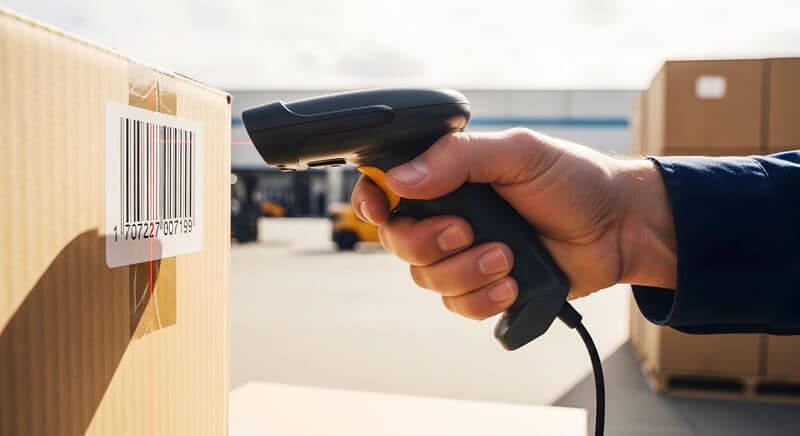
Traditionally, the process of pallet verification has relied on handheld barcode scanners and manual visual checks. Operators scan pallet and case labels, compare them against shipping documents, and perform spot checks to identify missing, incorrect, or damaged products. As shipment volumes have increased and product mixes expanded, this manual process have become harder to scale. Many boxed products looked nearly identical, with different SKUs distinguishable only by the label or barcode.
Challenge
A leading manufacturer of flooring and other surface solutions for residential housing, commercial spaces, and outdoor environments, faced this challenge in its palletized shipping operations. The company ships a high volume of boxed flooring products every day, where operators must confirm that each pallet contains the correct products and quantities before it moves forward.
Manual pallet verification was difficult to perform consistently in a busy loading dock environment. Operators needed to scan and check many labels during each shift, while pallets continued moving through the dock on a tight schedule. If a barcode was damaged, unreadable, or missing, staff often had to rescan multiple boxes or manually inspect the pallet to find the problem.
Handheld scanners could confirm that a barcode had been read, but they could not provide a complete visual record of the pallet or easily identify which specific box caused an issue. Spot checks also created the risk that mixed loads, missing cases, or incorrect quantities could be missed.
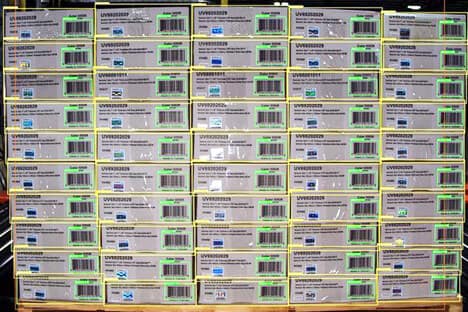
The manufacturing facility needed a more reliable way to verify pallet contents against order data, check all visible cases instead of only one sample, and guide operators directly to any problem areas. The solution also needed to integrate with existing PLC, WMS, and ERP infrastructure and scale to additional dock doors without changing established workflows.
Solution
To improve verification without slowing down throughput or adding labor, the manufacturer partnered with Accella AI to deploy Accella Dock Check™, a vision-based AI system designed to automate inbound and outbound pallet verification at the loading dock. Built on the Accella MFG Bot™ platform, the system uses deep learning to count cases, locate labels, read barcodes, and flag discrepancies before the pallet leaves the dock.
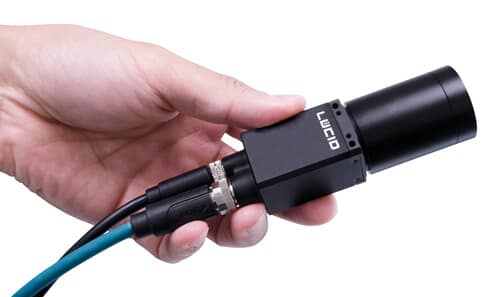
The system uses two LUCID Triton 24.5 MP (TRI245S-CC) cameras equipped with Fujinon’s 12 mm lenses and LUCID’s protective IP67 lens tubes. One camera captures the front of each pallet, while the second captures the back. This configuration provides high-resolution image coverage of visible cases and labels as the pallet moves through the inspection station.
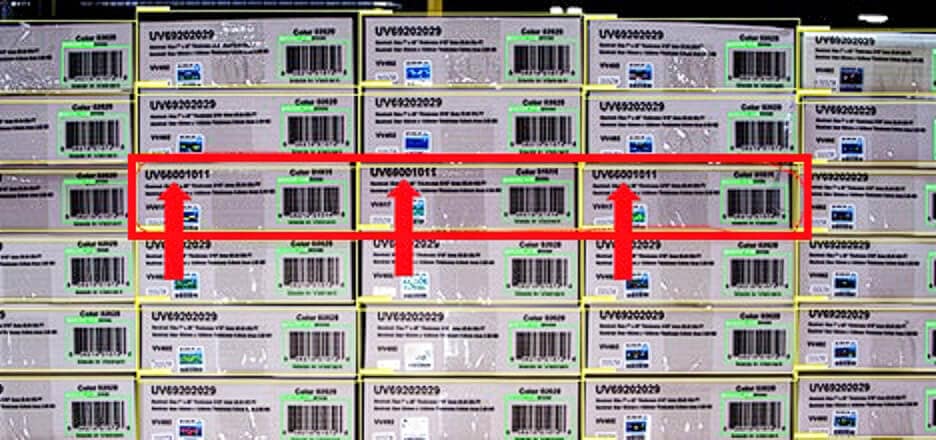
When a pallet arrives, the line’s PLC triggers both cameras. The images are sent to the Accella MFG Bot™ platform, where deep learning models detect the pallet, locate visible labels, count boxes, read barcode and printed code information, and compare the results against expected order data. If the pallet matches the expected shipment, it continues through the dock process. If the system detects an unreadable label, missing case, extra case, or incorrect SKU, the PLC flags the discrepancy, and the operator display shows the affected area directly on the pallet image.
This visual feedback is a key improvement over handheld scanning. Instead of only indicating that a barcode failed to read, the system shows operators where the issue occurred, allowing them to quickly repair a label, remove an incorrect box, locate a missing item, or correct the pallet before it leaves the facility.
The system integrates with the manufacturer’s existing automation infrastructure, including PLC, WMS, and ERP systems. Operator feedback can be displayed through plant-floor visualization tools such as Ignition by Inductive Automation. Inference runs on premises, helping keep dock images local while supporting real-time verification.
The same configuration can be used for outbound shipments against customer orders or loading plans, as well as inbound deliveries against purchase orders.
Conclusion
This deployment demonstrated that AI-based dock verification using LUCID cameras and Accella Dock Check™ can improve shipment accuracy and traceability without adding manual inspection steps. By combining high-resolution industrial imaging with deep learning, the system verifies pallet contents, counts visible cases, reads labels, and highlights discrepancies directly on the pallet image. Each pallet can be verified in approximately six to eight seconds, helping the system fit into high-throughput dock workflows.
For manufacturers shipping large volumes of palletized goods, automated dock verification provides a practical way to reduce errors, support operators, and improve quality control at one of the final checkpoints before products reach the customer.
To learn more visit:
Accella AI
Triton® camera product page