Support Center

Burnaby, BC, Canada – August 26, 2026 – LUCID Vision Labs, Inc., a leading designer and manufacturer of industrial cameras, today announced the availability of a new open-source AI development toolkit for its Triton® Smart camera. The toolkit gives developers greater flexibility to create and deploy AI models for on-sensor inference using Sony’s IMX501 intelligent vision sensor.
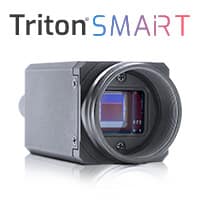 Designed for AI-enabled machine vision development, the toolkit allows users to customize their workflows, integrate preferred tools, and adapt models to specific application requirements. The initial release includes ready-to-use AI training samples based on open-source software (OSS) for image classification. LUCID plans to expand its open-source AI training resources with additional training samples, including samples for object detection and anomaly detection. LUCID also provides the Triton Smart Model Converter, which converts output files generated using the training samples into a format compatible with the Triton Smart camera. The converter and the open-source tools are available in a virtual machine (VM) image that provides users with a preconfigured development environment.
“The new open-source AI development toolkit gives developers greater control over how they build and deploy AI applications with the Triton Smart camera,” says Rod Barman, Founder and President of LUCID. “By combining an open development environment with AI processing directly on the image sensor, we are making it easier to create flexible, efficient, and self-contained edge vision solutions.”
The Triton Smart features Sony’s 12.3 MP IMX501 intelligent vision sensor, which integrates an Image Signal Processor, Digital Signal Processor, and 8 MB of on-chip memory. This architecture allows image classification and object detection to be performed directly on the sensor without requiring external processing or cloud connectivity. 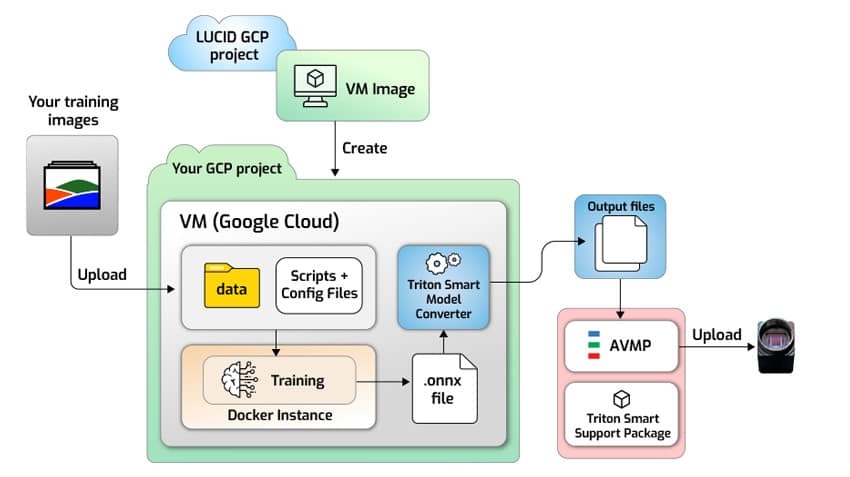
Once a compatible AI model has been prepared using the open-source toolkit and converted using the Triton Smart Model Converter, LUCID’s ArenaView MP software can be used to upload the model to the IMX501 sensor and configure camera settings. LUCID offers pre-compiled example programs to preview images with AI inference results. Processing AI models directly on the sensor helps reduce system latency, bandwidth requirements, power consumption, and reliance on host computing resources.
The Triton Smart’s dual-ISP design supports simultaneous AI inference and image processing, allowing the camera to output the original image, and AI results in a single data stream. Users can also reduce the output image resolution to improve privacy or bandwidth efficiency. The camera delivers up to 30 frames per second with inference or up to 8 frames per second at its full 4056 × 3040 resolution.
Built on LUCID’s Factory Tough™ platform, the Triton Smart combines on-sensor AI processing with a compact, lightweight 29 × 29 mm industrial camera design. It features robust M12 Ethernet and M8 GPIO connectors, an optional IP67 lens tube, and an operating temperature range of −20°C to 55°C. The camera is well suited for factory automation, smart logistics, retail analytics, access control, and other embedded edge-AI applications.
All LUCID cameras conform to the GigE Vision 2.0 and GenICam3 standards and are supported by the Arena SDK. The SDK is compatible with Windows, Linux 64-bit, and Linux ARM platforms and supports the C, C++, C#, and Python programming languages.
The preconfigured AI development environment for the Triton Smart camera is now available. For more information and to access the AI development toolkit, visit the Triton Smart product page or contact Sales.