Support Center



Sony IMX900 Sensor: Compact, High-Sensitivity, Global Shutter CMOS
Sony’s IMX900 delivers 3.2 MP imaging in a compact 1/3.1″ format, supporting small, lightweight, cost-effective S-mount (M12) lenses. Building on Sony’s 4th generation Pregius S technology, its redesigned pixel structure moves the memory units to a separate signal-processing area below the photodiode, leaving more room for a larger and deeper well. This improves light collection across a wider range of incident angles, boosting quantum efficiency, including in the near-infrared region.
Sony IMX900 Key Specifications
Resolution
3.2 MP
2048 x 1536 px
Sensor Size
Type 1/3.1"
5.81 mm Diagonal
Pixel Size
2.25 µm
Improved Pixel Structure
Sensitivity
90% QE
Peak QE @ 525 nm
Shutter Type
Global Shutter
Distortion-Free Imaging
A New Pregius S Pixel Design:
Optimizing Light Sensitivity
The IMX900’s redesigned pixel structure relocates the memory units to the signal-processing circuit area, freeing more space for a larger photodiode. This helps support smaller pixels while maintaining a high saturation signal. Its increased aperture ratio improves light collection at a wider range of incident angles, boosting quantum efficiency, while the thicker photodiode enhances near-infrared (NIR) and low-light sensitivity.
Higher Quantum Efficiency Across Visible and NIR
Sony’s IMX900 CMOS sensor brings high quantum efficiency to LUCID’s compact 3.2 MP global-shutter cameras. LUCID’s measured monochrome QE curves show the IMX900 reaching about 91% at 520 nm and retaining roughly 38% – 40% near 850 nm, demonstrating high sensitivity across visible and near-infrared (NIR) wavelengths. Compared with earlier Pregius sensors such as the 2nd generation Pregius IMX265 and 4th generation Pregius S IMX547, the IMX900 shows substantial QE gains in both wavelength regions while possessing a smaller pixel size of 2.25 µm compared to 3.45 µm (2nd Gen) and 2.74 µm (4th Gen). Its sensitivity also approaches that of STARVIS 2 sensors such as the IMX585, while bringing this level of visible and NIR performance to global-shutter imaging.
| Wavelength | Quantum Efficiency |
|---|---|
| 520 nm | IMX900: 91.01% |
| STARVIS 2 (IMX585): 94.40% | |
| 4th Gen Pregius: 69.92% | |
| 2nd Gen Pregius: 67.62% | |
| 850 nm | IMX900: 38.46% |
| STARVIS 2 (IMX585): 46.61% | |
| 4th Gen Pregius: 16.49% | |
| 2nd Gen Pregius: 17.44% | |
| 950 nm | IMX900: 18.81% |
| STARVIS 2 (IMX585): 25.03% | |
| 4th Gen Pregius: 4.10% | |
| 2nd Gen Pregius: 5.50% |
Quad High Dynamic Range (HDR)
The IMX900 organizes pixels into repeating 2 × 2 pixel arrays across the sensor. Users can set a different exposure duration for each pixel in an array, setting a specific pixel to either capture more detail in shadows (longer exposure) or highlights (shorter exposure). The four resulting images, each captured with a different exposure duration, are combined to create an HDR image off-sensor. Users can also set when each pixel exposure begins, allowing the timing to be staggered across the array. Together, varied exposure durations and staggered start times provide greater control when capturing useful information in high-contrast scenes. Please note this feature is under development.


LUCID Cameras Featuring IMX900

Ultra-Compact S-Mount Camera: Phoenix
LUCID’s Phoenix camera with Sony’s IMX900 sensor is available in an S-Mount configuration for space-constrained systems (P/N: PHX034S). The sensor’s compact 1/3.1-inch format pairs with the Phoenix’s 24 × 24 mm body to fit into tight spaces. The S-Mount model comes without a camera cover glass or IR filter, so users can install an S-Mount lens directly without removing either component.
Key Specs
Dimensions: 24 x 24 x 27.35 mm
Weight: 30g
Lens Mounts: C, CS, NF, S, No Mount, Ext Head
Max Framerate: 35.3 fps
Interface: 1GigE, PoE
2.5GigE IP67 Camera: Triton2
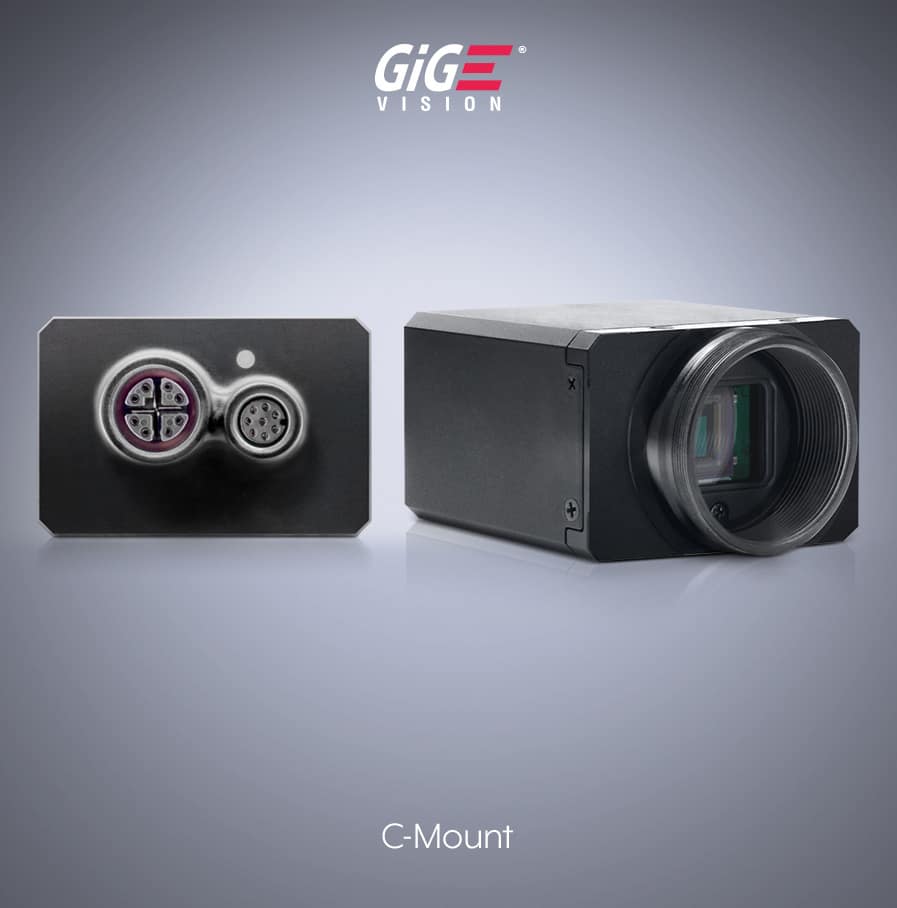
LUCID’s Triton2 camera combines Sony’s IMX900 sensor with a Factory Tough™ design built for demanding industrial environments. Its IP67-rated housing protects against dust and water, while the 2.5GigE interface supports frame rates of up to 78 fps. The camera also offers EMC industrial immunity, shock and vibration certification, and active sensor alignment to ensure accurate sensor placement across all units.
Key Specs
Dimensions: 44 x 29 x 45.3 mm
Weight: 90g
Lens Mounts: C, C to S-mount adapter available
Max Framerate: 78 fps
Interface: 2.5GigE, PoE

Built-In Illumination & Liquid Lens: Triton All-In-One
Coming in Q2 2027. At 44 × 29 × 72 mm and ~100 g, the Triton All-In-One combines essential imaging features with built-in liquid lens and lighting while maintaining the compact size and low weight of a conventional industrial camera. Enclosing both the lighting and lens within a Factory Tough™ IP67 case eliminates the need for an external IP67 lens tube, resulting in a significantly shorter overall length than traditional camera models.
Key Specs
Dimensions: 44 x 29 x 72 mm
Weight: 100g
Lens Mounts: Integrated S-Mount Liquid Lens
Illumination: Integrated 4 LEDs
Max Framerate: 78 fps
Interface: 2.5GigE, PoE