Support Center

CASE STUDY
Industry: Maritime
Product: 2.3 MP Phoenix Camera with Sony IMX392
Application: AI Fish Registration
SDK: ROS2 for Linux, Arena SDK
Automated Catch Registration for Small-Scale Fisheries Uses LUCID Phoenix Cameras
Small-scale fisheries face increasingly strict reporting requirements, often without access to reliable tools for estimating catch weight at sea. In Europe alone, approximately 75% of the 70,000 fishing vessels fall into the small-scale category. Despite their prevalence, these fisheries often lack access to advanced digital tools, even as regulatory requirements continue to increase.
Manual estimates are prone to error, and inaccurate reporting can lead to severe penalties and sanctions. For many fishers, especially those operating small vessels, the risk of penalties creates significant psychological stress and uncertainty during daily operations. As a result, fishers need a reliable, automated way to estimate catch weight directly on board.

Challenge
There were no commercially available solutions capable of estimating fish weight without using a physical scale. While academic research into camera-based weight estimation has existed for years, it has not been successfully commercialized.
In addition, designing a reliable vision-based system capable of operating at sea, including during harsh Nordic winters, presented a major engineering challenge. The device also needed to be compact and flexible enough to retrofit onto small vessels with limited space. In parallel, collecting not just a large volume of data but the right data for training robust machine learning models was critical to achieving reliable performance.
Solution
To address these challenges, CatchREG, a spinoff from Adigo Mechatronics, developed a compact, camera-based catch registration system designed specifically for small vessels. The company’s objective was to improve the accuracy and reliability of catch data collection, supporting improved fisheries management while reducing the reporting burden on fishers. CatchREG’s approach is enabled by a unique, proprietary dataset covering multiple fish species, weights, vessels, and landing sites, allowing automated estimates that match or exceed the accuracy of manual methods.
The system images fish as they pass along a tray on board the vessel, using computer vision and machine learning to automatically classify species, weight, and quantity of each fish in real time.
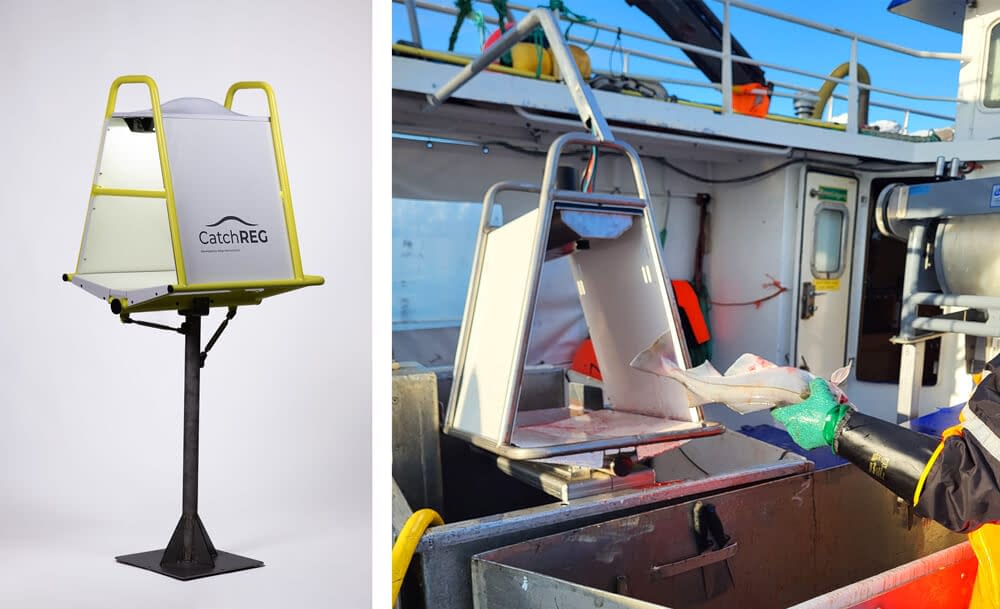
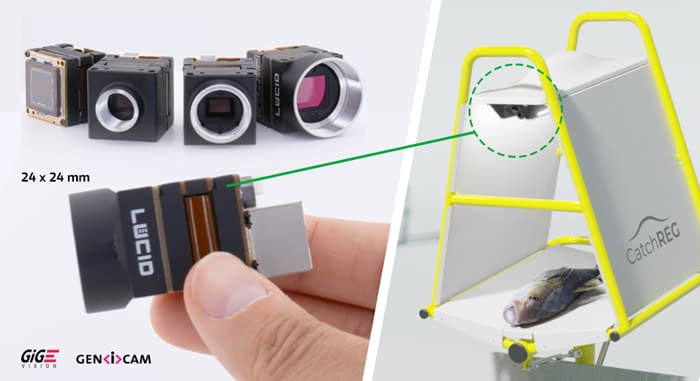
LUCID’s compact Phoenix 2.3 MP Sony IMX392 camera is a core component of the CatchREG system and was selected early in development as a non-negotiable element of the design. The flexibility and robustness of the Phoenix camera proved especially valuable when optimizing camera placement within the constrained mechanical layout of the device.
The camera is connected to the onboard computer via GigE, providing flexibility in where processing hardware can be installed within the vessel. Image acquisition is triggered by an external signal and synchronized with the CatchREG lighting system. This ensures sufficiently short exposure times to capture fast-moving fish while still producing sharp, high-quality images suitable for machine learning analysis.
The camera is controlled through a ROS2 node using LUCID’s ROS2 driver, enabling tight integration with the rest of the CatchREG software architecture. This setup supports reliable triggering, synchronization, and real-time image streaming in a challenging marine environment.
For end users, the primary benefits are a significantly reduced risk of penalties and sanctions, and a simpler, more reliable reporting workflow. CatchREG systems now routinely deliver catch estimates with less than 2% error in real-world operation. Fishers also benefit from live visibility into their catch, allowing them to forecast total value during operations rather than waiting until landing.
Conclusion
By combining robust machine vision hardware with advanced machine learning, CatchREG has delivered a practical, commercially viable solution to a long-standing challenge faced by small-scale fisheries. The integration of LUCID’s Phoenix camera enables reliable, real-time catch estimation in harsh marine environments, helping fishers meet regulatory requirements with confidence while improving the quality of fisheries data for long-term resource management.
To learn more visit:
CatchREG
Adigo Mechatronics
Phoenix Camera Product Page