백서 다운로드

10GigE 및 차세대 고속 카메라를 위한 RDMA 기술의 장점
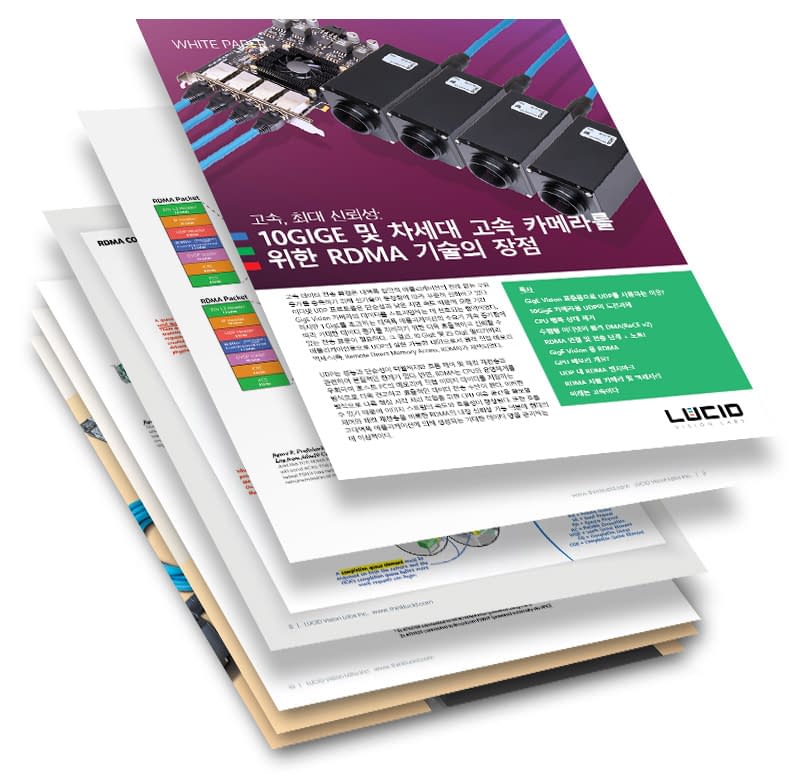
10GigE 및 차세대 고속 카메라를 위한 RDMA 기술의 장점

이 백서에서는 RDMA 기술이 고속 이더넷 머신 비전 카메라를 어떻게 변화시키고 있는지에 대해 자세히 설명합니다. 이 백서에서는 RDMA의 기원과 메커니즘, RoCEv2 표준을 살펴보고 TCP 및 UDP와 같은 기존 프로토콜과의 자세한 비교를 제공합니다. 이 백서에서는 데이터 전송이 CPU와 OS를 우회할 수 있는 RDMA가 제공하는 제로 카피 전송 기능을 강조합니다. 또한 이 백서에서는 예비 벤치마크 결과를 포함하여 이 기능이 10기가 및 25기가 카메라에 어떤 영향을 미치는지에 대한 포괄적인 개요를 제시합니다. 이 백서를 읽으면 RDMA 기술이 머신 비전 카메라 산업에 미치는 영향에 대한 귀중한 통찰력을 얻을 수 있습니다.

목차:

– GigE Vision 표준용으로 UDP를 사용하는 이유?
– 10GigE 카메라용 UDP의 도전과제
– CPU 병목 상태 제거
– 수렴형 이더넷의 원격 DMA(RoCE v2)
– RDMA 연결 및 전송 단계 + 노트!
– GigE Vision 용 RDMA
– GPU 메모리 개요?
– UDP 대 RDMA 벤치마크
– RDMA 지원 카메라 및 액세서리
– 미래는 고속이다

“제출”을 클릭하면 다운로드 링크가 제공됩니다.
(영어, 일본어, 한국어, 중국어 PDF 다운로드 가능)

Sneak Peek

Surviving Industrial Challenges To build these compact embedded vision systems however, application designers must navigate the challenges of harsher operating environments and the complexities of building smaller, faster, more power efficient systems. They must work to validate their system through time-consuming stages, starting from the proof of concept (POC), to prototyping, and finally to a minimum viable product (MVP) or a Full Custom Design (FCD). Off-the-shelf embedded development kits, such as those from NVIDIA, Xilinx, or Raspberry Pi offer a quick solution to building a proof-of-concept design. However, many camera modules and embedded development boards offer little to no protection from the harsh environments of industrial spaces. A considerable amount of time must be spent on designing and testing prototypes that are protected against dust and moisture (IP67 or IP65), electromagnetic interference (EMC immunity) and ... Fill out the form above and download the full white paper Adapting RDMA over the Ethernet network enables the following benefits:
• Fastest throughput and lowest latency available at all speeds of Ethernet networks, compatible with existing switching infrastructure and cabling.

• Complete hardware offload of packet handling with no CPU involvement through zero-copy; ability to send and receive data to and from remote buffers.

• Comprehensive ecosystem of industrial connectivity solutions offering secure connectors, EMI shielding, ground isolation, and Power over Ethernet (PoE).

• Supported by many vendors of both hardware and software solutions — including Broadcom, Marvell, Nvidia, and Intel — promoting interoperability.
The Host Channel Adapter (HCA) manages RoCE operations, implementing in hardware all the logic needed to execute RDMA protocol. Data segmentation and reassembly as well as flow control are managed by the HCA allowing the sender and receiver applications to work with whole buffers. The RDMA channel is initiated by “pinning” memory. A memory region is reserved on the host for RDMA usage, the necessary protections are applied, and then the host passes the address to the HCA and removes itself from the data path. This registered memory region can now be used for any RDMA operation, bypassing the operating system, and generating no additional CPU load.

RoCE RDMA transactions use three queues. The send and receive queues handle all the data transaction and are always created together as a queue pair (QP). The completion queue (CQ) is used to track the completion of the work scheduled on the QP. The QPs enables application-level flow control to notify the sender of available buffers for RDMA transfer on the receiver’s end.
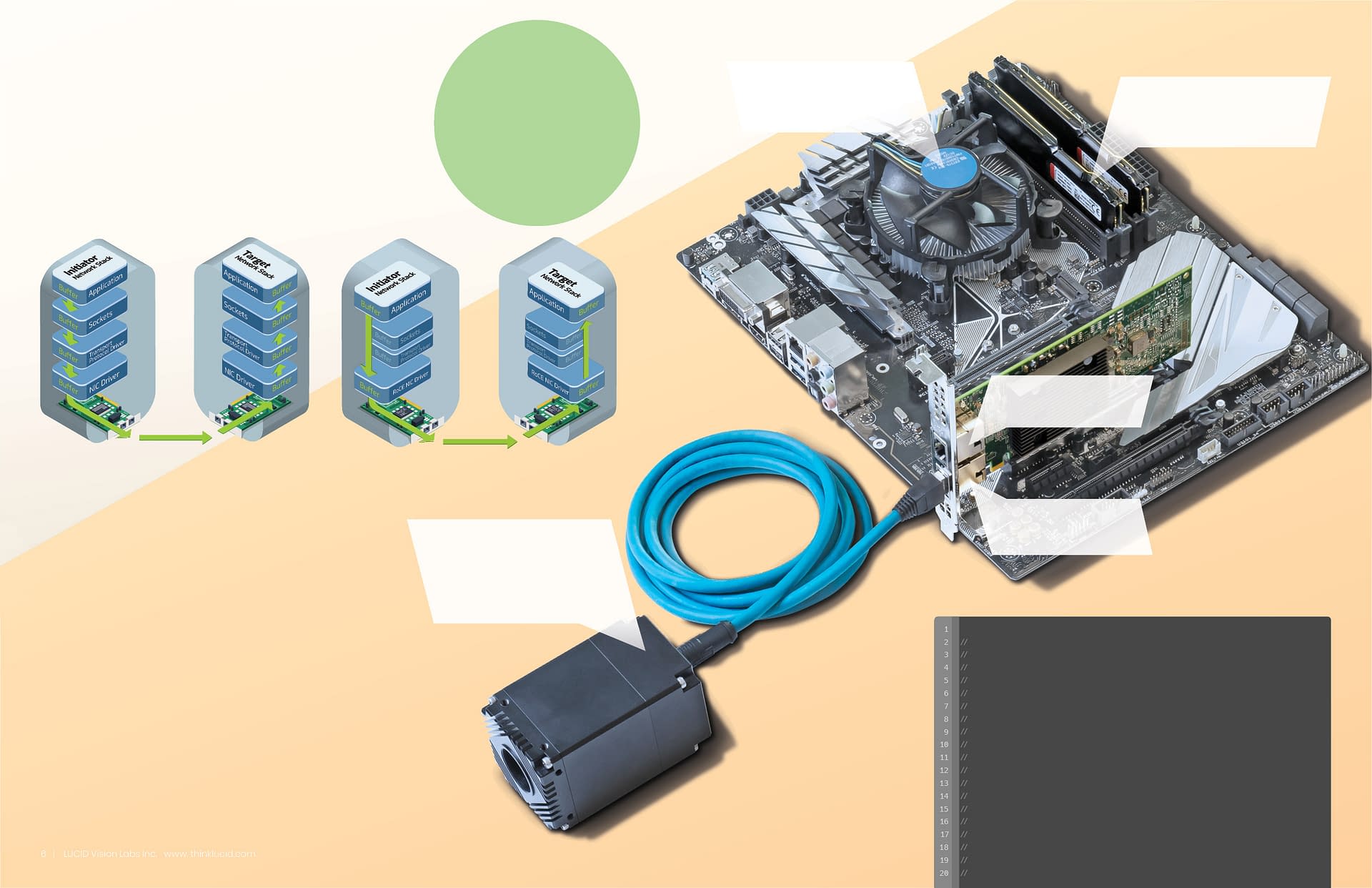
figure 7: In a conventional networking stack (left), data transfer from one application to another application on a remote machine involves multiple buffer copies and context switching to mobilize the CPU at each stage. In an RoCE network, data is transfered directly from the initiator application to the target application with no CPU involvement, bypassing the OS stack entirely.
What do you need to enable RDMA with
LUCID 10GigE Cameras?


• LUCID Atlas10 camera with RDMA firmware
• RDMA 10GigE Host Channel Adapter (HCA)
• (Optional) 10GigE Switch with PFC priority-enabled VLAN
• Cat6 or better Ethernet cable
Before RDMA data transfers can take place, a queue pair (QP) and a completion queue (CQ) must be created for each hardware port, known as a channel adapter (CA) on the RDMA network.
What is needed on the camera:
Camera QP (Send and Receive Queues)
Camera CQ (Completion Queue)
Registering and reserving host memory for RDMA user applications is possible thanks to Network Direct in MS Windows® and the Libibverbs library in Linux. RDMA data transfers can only start after memory is registered. This is done by “pinning” the host’s memory. A memory region is reserved by the OS and registered with the HCA. Host Channel Adapter (HCA) Port 2.
HCA2 QP (Send and Receive Queues)
HCA2 CQ (Completion Queue)
Host Channel Adapter (HCA) Port 1.
HCA1 QP (Send and Receive Queues)
HCA1 CQ (Completion Queue)
How are RDMA devices programmed in applications? It starts with RDMA verbs, which are the low-level building blocks for RDMA applications. They are accessed by various API libraries, however, the two major libraries used are Libibverbs API for Linux and Network Direct SPI for Microsoft Windows. These APIs allow RDMA devices to establish channel adapter connections, pin and register memory, execute data transfers, and terminate connections.

There are two types of Verbs: one-sided and two-sided verbs. One-sided verbs allow remote devices (such as cameras) to completely bypass the CPU/OS when sending data. Two-sided verbs act more like traditional sockets that utilize the CPU/OS. LUCID uses two-sided verbs. Using two-sided verbs still removes several sources of CPU overhead compared to conventional Ethernet data transfers. Using two-sided verbs is necessary for requeuing transfers and polling the CQ. These tasks take up negligible CPU resources.
======RDMA Verbs and Verbs APIs======
10GigE RDMA White Paper