PDFガイドブックダウンロード

Time-of-Flight Guidebook 2.0: 3D性能を向上させ、設計にかかる時間とコストを削減するヒント

time-of-Flight Guidebook 2.0 LUCID Helios2

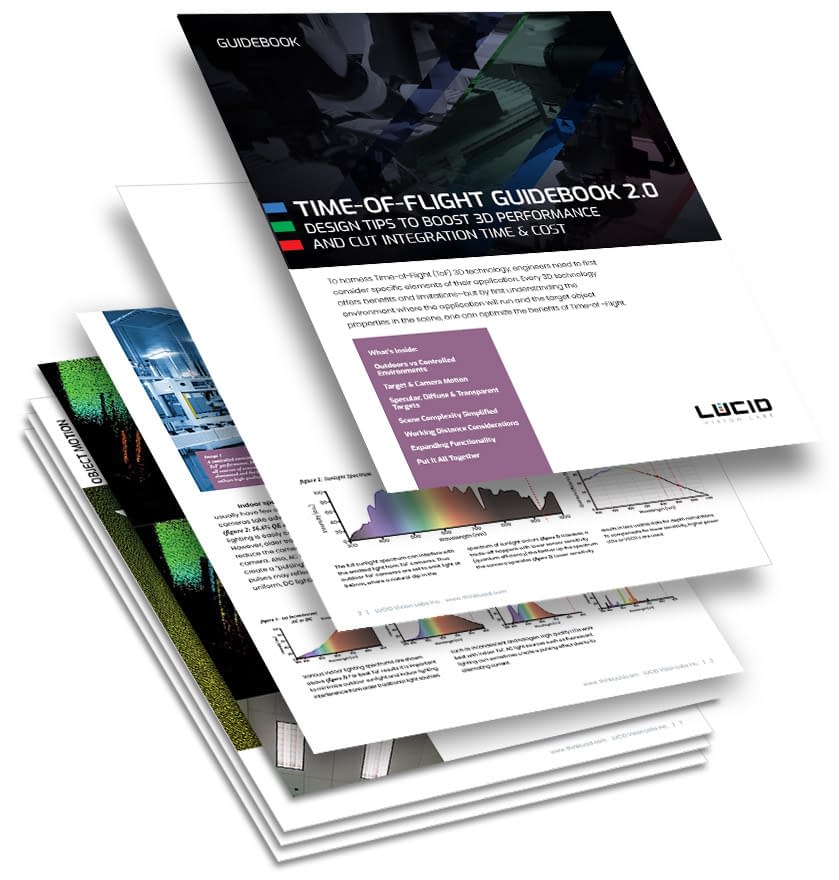
3D飛行時間型画像処理アプリケーションのパフォーマンスを向上させ、同時にインテグレーションにかかる時間とコストを削減する方法をご存知ですか?Helios2のハンズオンガイドブックでは、アプリケーションの環境やシーン内の対象物の特性など、さまざまな要因を考慮することで、飛行時間計の利点を最適化する方法を説明しています。また、さまざまなHelios2モデルが、3Dアプリケーションの一般的な課題をどのように解決するかもご覧ください。

目次:

• 屋外と管理された環境の比較
• 被写体とカメラのモーション
• 高反射、低反射および透明な対象物
• シーンの複雑さを簡素化する
• Working Distanceの考慮
• カメラ機能の拡張
• まとめ

送信」をクリックすると、ダウンロードリンクが表示されます。

– サンプル章 –

SPECULAR, DIFFUSE & TRANSPARENT TARGETS ToF works best on targets with surfaces that have neither high specular reflection (i.e., mirror-like) nor absorbent non-reflective surfaces. Both extremes lead to point cloud distortions. For example, black PVC piping has both low reflectivity (black color) and highly specular surfaces, creating both voids and spikes in the point cloud (Image Set 4, Example c.) Targets that are black or very dark will absorb light and thus return the least amount of light creating voids or holes in the point cloud. Targets with high specular reflections can saturate pixels creating spikes in the point cloud that are closer in distance than their true position. Targets with these properties may not be suitable for ToF.
Targets with diffuse surfaces and high reflectivity work best for ToF (Image Set 4, Example a, b, d). These targets send enough light back to the ToF sensor without specular reflections. Some objects however, exhibit properties that are less than ideal but are still discernible within the scene. In these situations, it is possible to increase target details via changes in exposure time and gain, image accumulation, and filtering.
Determining the best exposure time maximizes usable depth data for both high- and low-reflectivity targets. The Helios2 camera models enables three discrete exposure time presets as well as high and normal gain settings. Longer exposure times and high gain should be used for scenes further from the camera, or when imaging objects with low reflectivity. Shorter exposure time and normal gain is used for scenes closer to the camera, or objects that appear over saturated. EXPOSURE TIME AND GAIN IMAGE ACCUMULATION The Helios2 processing pipeline is capable of accumulating multiple frames for improved depth calculations. This is helpful for targets that produce noisy data. With image accumulation, depth frames are averaged over a set number of frames, improving imaging results. It should be noted that the higher the number of frames accumulated, the slower the depth data generation, as more images must be captured to calculate the data. CONFIDENCE THRESHOLD Depth data confidence is based on a level of intensity for each point. If a returning signal is too weak, there is low confidence in the resulting depth data. Thresholding removes depth data with low intensity/confidence, improving scene clarity. SPATIAL FILTERING Spatial filtering reduces noise by adjusting and averaging depth data differences between neighboring pixels—smoothing out surfaces. Additionally, the Helios camera also uses edge-preservation in its spatial filtering, reducing noise in surfaces while maintaining object-edge sharpness.
The Helios2 processing pipeline is capable of accumulating multiple frames for improved depth calculations. This is helpful for targets that produce noisy data. With image accumulation, depth frames are averaged over a set number of frames, improving imaging results. It should be noted that the higher the number of frames accumulated, the slower the depth data generation, as more images must be captured to calculate the data. HIGH DYNAMIC RANGE (HDR) MODE: HELIOS2+